What is information?
It seems like a simple question, but turns out to be very difficult to answer.
We all use the word in our vernacular, heck, we even live in the Age of Information.
So… what is it?
Is there information in a book?
Obviously there is! Read it and you will know something new.
What if the book is in a language you don’t understand?
Does the book have no information in it because YOU can’t read it?
That seems silly; SOMEONE could read it and learn something new, so there must still be information in it.
What if the book is in a language that no one on Earth can speak?
Now, does the book have no information in it?
Is the information in the book there because of you, because of someone being able to read it and learn something?
Or will there still be information in the book long after the last human has ceased to exist?
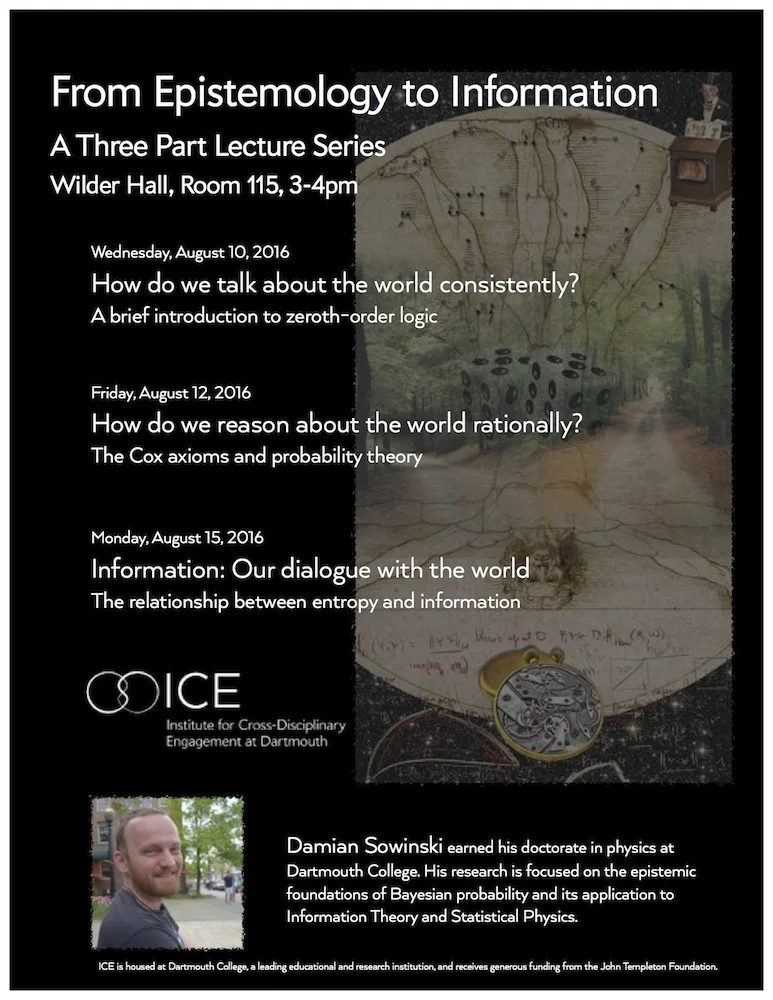
In this lecture series I examine the relationship between ourselves and the world, and try to pin down what information is. In the first lecture, How do we talk about the world consistently?, I build a language to describe the world from the ground up. Consistency of valuations on logical connectives provide such a strong constraint that the resulting language is good-old sentential logic.
In the second lecture of the series, How do we reason about the world rationally, I construct a graded valuation on the language - belief. Again, consistency provides a powerful constraint, forcing the algebra of belief functions to satisfy the same rules as probability functions. This approach, pioneered by Richard Threlkeld Cox, provides a rigorous foundation for the Bayesian interpretation of probability theory.